
Jefferson Previous Residents by Address
The strongest Jefferson address trail uses layers in sequence. The Jefferson County Appraisal District identifies the present parcel and its legal description. The County Clerk connects legal descriptions and parties through recorded documents. Tyrrell and the Sam Houston Regional Library and Research Center carry the older bridges that a web index does not fully replace. Directories and census material help separate people who occupied an address from people who held title to it. The table below describes the documented coverage rather than suggesting that any one source is complete.
| Source | Years it covers | Where held | What it can show |
|---|---|---|---|
| JCAD parcel search | Current portal; historical start not stated | Online JCAD | Owner, identifiers, situs and mailing fields, legal description, value, and tax-year fields |
| County Clerk public-record portal | Certified through 08/28/2026; earliest online year not stated | Official Records Search | Recorded deeds, liens, and plats by party, term, date, or OCR route |
| Sam Houston deed material | Deeds 1834 to 1887; index 1836 to 1888 | Sam Houston Center microfilm | Older deed records and indexed names |
| Tyrrell deed index | 1836 to 1946 | Tyrrell Historical Library | Local bridge to historic legal records |
| Beaumont directories | Begins 1903; dated Polk entries through 1983 | Tyrrell, UT Briscoe, and other holdings | Names, addresses, telephone listings, and historical household detail |
| Federal census | 1790 to 1920 at Tyrrell; later schedules release under the 72-year rule | Tyrrell, NARA, and FamilySearch | Household members and census-year context |
Use the parcel and deed chain first when the aim is a transfer history. Use the directory and census pair first when the aim is the people at the address. Newspaper, probate, permit, and map evidence can then test the gap between those records. The county's current property tools are useful leads, but a mailing address is not proof that an owner lived at the parcel.
Note: Preserve the address as printed in each record because historic street wording may not match a current postal format.
Jefferson Previous Residents Beyond Web Indexes
The Jefferson County Clerk Official Records Search offers Quick Search and Advanced Search for grantor, grantee, subdivision, document type, document number, and recorded-date ranges. It also offers Index Only and Index & Full Text OCR modes. The portal is a valuable current route, but it does not state its earliest online index year. OCR can assist with typed legal descriptions, yet it can also misread names. Search the index first, then use OCR when the legal description is likely to be typed or scannable.
When the online trail stops, move through the documented fallback chain: request or inspect the County Clerk record, use county deed books or indexes at the counter, consult Sam Houston microfilm, and ask Tyrrell about its deed index. The Clerk's 2024 annual report says legal-record digitization is reaching back to 1966 through 2026. That initiative may expand online coverage, but it is not a guarantee that every older image is searchable or available from the portal.
This matters for Jefferson previous residents because the earliest online date is unknown. An empty search screen can mean the record predates the online range, uses a different spelling, or needs a lot, block, subdivision, or book-and-page route.
Walk Jefferson County's Deed Chain
A deed chain follows a parcel backward, not a name list forward. Start with the current parcel card in the Jefferson County Appraisal District search. Record the owner name, mailing and situs fields, property or geographic ID, subdivision, lot or block, legal description, and tax year. The mailing field may point elsewhere, and neither it nor an ownership field proves physical occupancy. The legal description is the stable key when an old address has changed format.
- Search the current owner as a grantee in the Clerk's official-records portal and compare the parcel's legal description.
- Record the purchase deed, its date, document number, grantor, grantee, legal description, and any reference to an earlier document.
- Search the seller from that deed as a grantee before the purchase date to find the seller's own acquisition.
- Repeat the process backward, following lot, block, plat, abstract, or legal description when a street label changes.
- When the portal stops, use the Clerk counter, deed books, Tyrrell's index, or Sam Houston microfilm for the earlier period.
- Grantor and grantee
- The grantor transfers an interest in a recorded document. The grantee receives that interest.
- Chain of title
- The sequence of recorded transfers used to follow a parcel from one owner to an earlier owner.
- Legal description
- A lot, block, subdivision, metes-and-bounds, or similar parcel description that is more durable than a street label.
The address-focused Jefferson street directory explains current records by street. This backward workflow uses those records only as the starting point for historical transfers.
Jefferson Previous Residents Before 1966
Tyrrell's historical guide identifies a Jefferson County Index to Deeds running from 1836 to 1946. The Sam Houston Center adds deed records from 1834 to 1887 and index reels from 1836 to 1888. These overlapping ranges are bridges, not interchangeable copies. A researcher should note which repository, record group, volume, reel, and page supplied a finding. A date range on a guide does not establish that every deed image or every name is searchable from home.
The Sam Houston Center's Jefferson County guide also lists marriage records from 1837 to 1926 and probate material from 1837 to 1879. Those collections can explain a surname change, an heir transfer, or the timing of a transaction. They do not by themselves prove that a named person occupied the street address. Keep ownership and household evidence as separate notes until the records connect them.
The microfilm guide shown in the project image documents the older Jefferson deed range and index reels.
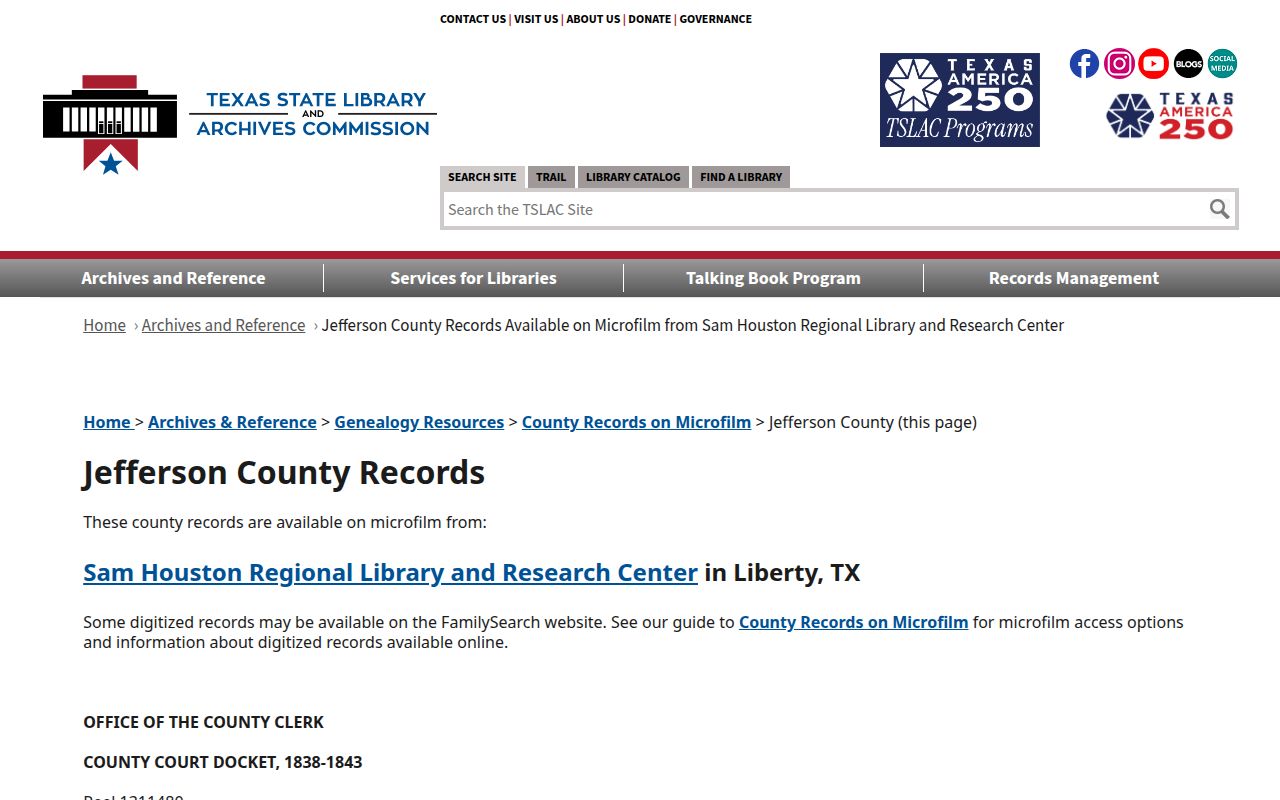
The documented reels provide a practical next step when an online grantor or grantee search cannot reach the earlier transfer.
Jefferson Maps Date a House
Maps can set the physical context for past residents without pretending to be a name list. The Library of Congress Beaumont Sanborn collection has 107 sheets for 1911 and is public domain. It can show a building footprint, construction material, use, street name, and lot setting at that date. The 1902 Nelson & White landownership map, the c.1850 Town of Beaumont map, a 1901 oil-field map, and later state archive maps help compare the same area across time.
The Spindletop boom is a local reason to make that comparison. Research notes that Beaumont grew from about 9,000 to 30,000 people in a few months after the 1901 discovery. A street can therefore appear in a fast-changing setting in early directories, deeds, and newspaper notices. Use the map to test street and parcel continuity, then use a directory, census, or deed to identify a person.
Note: A Sanborn sheet describes the built environment and street context, not the identity of everyone who may have lived there.
Jefferson Previous Residents in Directories
Past residents are not always the people named in a transfer. Beaumont directories begin in 1903, and the R.L. Polk catalog covers Beaumont, Nederland, and Port Neches in dated volumes through 1983. At Tyrrell, look first for a name in the alphabetical section, then ask whether an address or criss-cross section is available. Exact separate reverse-directory years were not established in the reviewed sources, so confirm what the library holds before relying on an address section.
Pair a directory nearest the target year with a census year. Tyrrell reports census microfilm and indexes from 1790 through 1920, and the Sam Houston guide specifically lists Jefferson County's 1870 and 1880 census material. The directory can give an address snapshot and a telephone or business detail when printed. The census adds people in the household, ages, and relationships. Federal schedules after that period are released according to the 72-year rule.
- Copy the directory spelling, address wording, page, year, publisher, and any abbreviation.
- Check the nearest census year for the household and preserve its district, page, and date.
- Compare the next directory volume for a move, changed name form, or omission.
- Use the deed chain to test title changes and the newspaper run to test a move, death, or marriage notice.
The historical volumes themselves are covered on the Jefferson city directory collections page, which explains their catalog dates, entry conventions, and library access routes.
Jefferson Previous Residents, Permits, and Probate
City records can add dated evidence around an address. Beaumont's Building Codes page directs users to the City Works permit portal, where permit material may show a work description, work address, application or trade type, and inspection path. A permit holder can be different from the parcel owner, so use it as a dated address lead. Beaumont's public maps also include permit and code layers, but the city says those maps are general-information tools rather than official maps. Request an official file through the City Clerk or the responsible department when that distinction matters.
Probate can explain why a deed moved to heirs. The County Clerk probate request form supports a name search and requests for a will, inventory, order, or other case document. Research lists a $10 nonrefundable name search when a case number is unknown, with email or mail routes for the request. Compare the deceased person's name, death date, case number, document type, and legal description to the deed chain. An obituary or the Enterprise and Journal run can provide a date to guide that search.
The Tyrrell research guide brings deeds, directories, marriage records, yearbooks, newspapers, tax and probate material together for Jefferson historical work.

The guide is a reminder to test a name and address across several dated sources instead of treating one portal result as the full history.
Jefferson Addresses Need Legal Descriptions
Address continuity is the main safeguard in a Jefferson previous-resident search. No reviewed official source established a countywide street-renumbering year or a named Beaumont renumbering project. Do not invent one from an apparent mismatch. Instead, bridge an old address through the subdivision, lot and block, legal description, historical map, adjacent cross streets, and parcel identifiers. Plats can connect a lot and block to a street, while metes-and-bounds descriptions require attention to their calls and landmarks.
Use this research for family history, estate or heir questions, and personal house-history curiosity. Do not use old address findings to stalk, harass, or track a living person. Where a public record is unclear or restricted, ask the responsible clerk, archive, or custodian for the proper access route rather than trying to combine incomplete records into a claim.
Lawful use. Jefferson address history is best used for family, heir, and historic-property research, never to harass or target living people.
Note: The legal description and a dated source citation make an old-address conclusion easier for another researcher to check.